Settings
Configuration of Expert Controller Plus is supported using the ‘Settings…’ menu item. It has four sub-menu’s, Connections, Groups, Amplifiers and Application. These are detailed below.
When moving between groups or closing the Settings window the application will automatically save changes.
Connections
Connections are presented as an Apple Split View window. The left-pane lists existing connections and permits selection of a Connection for update. A selected Connection is presented in the right-side pane.
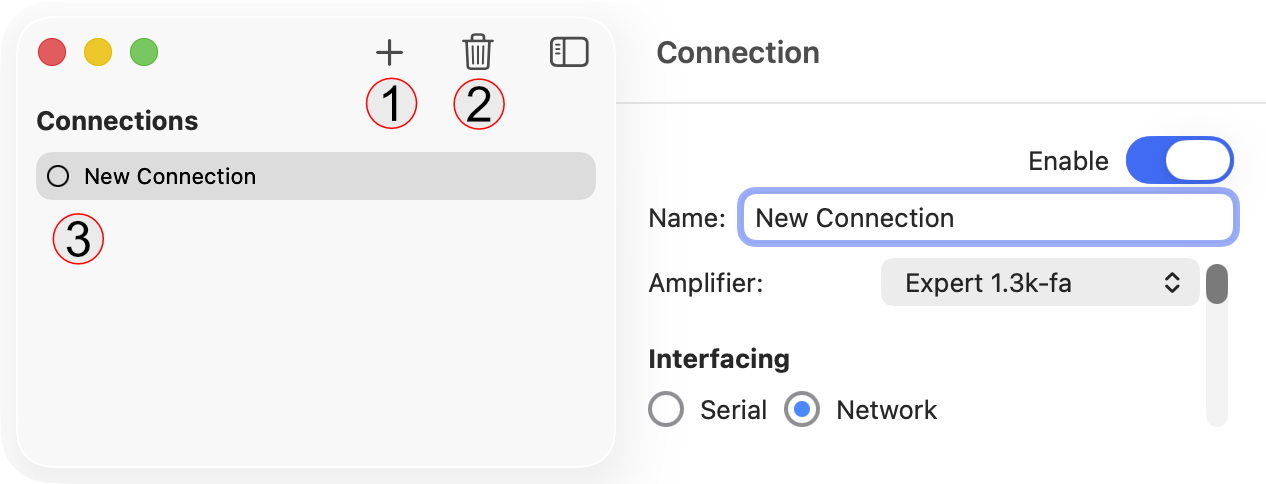 Three options are annotated in the figure above, these are detailed below:
1 - Add a new Connection, new Connections are named ‘New Connection’ by default.
2 - Delete the selected, existing Connection.
3 - List of all existing Connections.
The following sections describe each configuration item.
Enable
When a Connection is Enabled it may be started/stopped etc using the Activation manager. Disabling a Connection provides a way to hide Connections that are not used but wish to be retained for possible future use.
Default: Enabled
Name
The name of the Connection. This should be a name that uniquely identifies this Connection to a user. It is the name used to identify Connections in the Activation manager.
Default: ‘New Connection’
Amplifier
The model of Expert amplifier connected to the interface described by this Connection.
Select the model of amplifier from the list.
Default: ‘Expert 1.3k-fa’
Interfacing
Select the type of interface used by this Connection: Serial or Network.
Serial identifies that Expert Controller Plus will use a Serial interface to communicate with the Expert amplifier.
Network identifies that Expert Controller Plus will use TCP/IP networking to connect to the Expert amplifier described by this Connection. As Expert amplifiers don’t implement a native network interface, Expert Controller Plus will use TCP/IP to connect to a network/serial adapter. The adapter must be configured and connected to the Expert amplifier using a serial connection.
Default: Serial
When ‘Serial’ is selected the following may be configured:
Interface
The macOS name of the serial interface that is connected to the Expert amplifier.
A list of serial interfaces known to macOS can be accessed using the drop-down control of the field.
Default: The first interface identified by macOS
Bit rate (bits per second)
Is the rate in seconds that data-bits are transferred across the serial interface. Several options ranging from 9600 to 230400 are available. The faster the selected rate the less time is required to transfer data between the amplifier and Mac. The default has been identified as sufficiently fast to achieve responsive results.
Default: 115200
Raise RTS on connect
When either Expert Controller Plus is launched the application will assert an RTS signal to awake an amplifier. This ability allows an amplifier to be awoken on application launch or when a Connection is started.
If the connected amplifier is already awake, requesting that it awake has no effect.
When not selected, the amplifier must be awoken by an alternative method before Expert Controller Plus can establish communications. Alternative methods may include using the amplifier front-panel controls to ‘turn-on’ the amplifier.
Default: Off
Drop RTS on disconnect
This option ensures the RTS signal is not asserted when Expert Controller Plus is disconnected from an amplifier. If an amplifier was awoken by raising the RTS signal, this will cause it to enter a sleep state.
It has been observed that some serial interface hardware will not drop an RTS signal when software closes an interface and, for those, this option can force the RTS signal to not be asserted prior to interface closure. However, most interface hardware appears to de-assert RTS when an interface is closed by software and, for those interfaces, this option will have no effect.
The functionality to de-assert RTS on disconnect is independent of, the ‘Send Off command on disconnect’.
Default: Off
Adapter FQDN / IP Address
This is the Fully Qualified Domain Name or IP address of a network/serial adapter. Examples of valid values are: 192.168.1.100 (IPv4), fd00:192:168:111::100 (IPv6), waveshare.somedomain.org. Hostnames without a qualifying domain name suffix are not supported.
As information is typed it is validated by Expert Controller Plus. If the information is considered invalid it is coloured red and a thumb-down graphic displayed.
If the IP address is a local network address macOS will request that permission be granted to Expert Controller Plus for it to access local network devices. It will request this permission just once, the first time a connection is attempted, and will remember your choice thereafter. For Expert Controller to access a network/serial adapter connected to the local network it must be granted this permission. This permission may be later changed in the macOS System Settings | Privacy & Security | Local Network area.
Default: 192.168.1.100
TCP Port
The TCP port number on which the network/serial adapter is listening for incoming connections from clients such as Expert Controller Plus.
Default: 4196
Use MODBUS TCP to wake/sleep amplifier
Default: Off
Adapter FQDN / IP Address
Default: 192.168.1.200
TCP Port
Default: 502
Wake and Sleep
Default: Wake Off, Sleep Off
Unit
Default: 01
Function
Default: 05
Register
Default: 0000
Command
Default: Wake FF00, Sleep 0000
Auto connect with amplifier on App launch
When selected, Expert Controller Plus will automatically attempt to establish communications with an amplifier using the configured interface when it is launched or a Controller window is opened. To disable this capability and require all connections be initiated by an operator, deselect this option.
Default: Off
Send Off command to amplifier on disconnect
This option identifies whether Expert Controller Plus will send the amplifier an Off/Shutdown command when the connection is disconnected. Sending such a command will cause the amplifier to sleep regardless of RTS signalling should a Serial interface be selected.
If this option is selected and a Network interface is used, Expert Controller always send the Off/Shutdown command. When using a Serial interface, Expert Controller will only send the Off/Shutdown command if option ‘Raise RTS on connect’ option is not selected.
Default: Off
Default windows
Expert Controller Plus supports four different windows:
1 - LCD panel and all buttons
2 - LCD panel only
3 - Frequently used buttons only
4 - LED panel only.
The desired window types to be opened when a Connection is started.
Select none, all or whichever are required.
When no window is opened by default, the user will need to open a window manually to interact with an amplifier.
Default: LCD panel and all buttons only
Close default windows on connection stop
When the Connection is Stopped/closed all windows opened by default will be closed when this is On.
Default: On
LCD Colour
The virtual LCD panel colour used in windows that contain an LCD panel.
Four colours are supported: ‘Cool blue’, ’Warm white’, ‘Green black’ and ‘White black’.
Note: The selected colour scheme is for Light mode only. When in Dark mode the foreground text is Green and the background, Black.
Default: Cool blue
Spoken report Volume and Rate
The volume of the spoken announcement, relative to the master macOS volume, may be tailored. For example, when set at its maximum, the volume of the spoken report will be at the same level as the master volume set in macOS. By default, the volume is set to be 50%, a value of 5, that of the master volume.
The rate at which words forming the report are spoken may be adjusted using this control. The lower the value the slower the speech, conversely, the higher the value the faster the speech.
Default: Volume 5 / 50% and Rate 5 / 50%
Spoken report content selection
The spoken status report comprises twelve types of information, each of which may be included or excluded as desired.
1 - Virtual LED status
Two windows, ‘LCD panel and all buttons’ and ‘LED panel only’ contain multiple virtual LEDs. When selected the state of each virtual LED will be included in the spoken report.
2 - Band
When selected the Band on which the amplifier is operating will be included in the spoken report.
3 - Output power
When selected the instantaneous RF output power as reported by the amplifier is included in the spoken report.
4 - PA Voltage
When selected the Voltage of the amplifiers, Power Amplifier sub-system is included in the spoken report.
5 - Memory bank
When selected the memory bank currently in use by the amplifier is included in the spoken report.
6 - Antenna
When selected the amplifiers, currently selected antenna is included in the spoken report.
7 - SWR (Before ATU)
When selected the Standing Wave Ratio (SWR) prior to the amplifiers internal ATU is included in the spoken report.
8 - PA Current
When selected the Current, expressed in Amps, of the amplifiers, Power Amplifier sub-system is included in the spoken report.
9 - Input source
When selected the amplifiers input source is included in the spoken report.
10 - Power level
When selected the power band (min, mid, max) of the amplifier is included in the spoken report.
11 - SWR (After ATU)
When selected the Standing Wave Ratio (SWR) after to the amplifiers internal ATU is included in the spoken report.
12 - Temperatures
When selected the three temperatures - upper, lower, combiner - as measured by the amplifier are included in the spoken report.
Default: Virtual LED status, Band, Output power and Power level selected
Groups
Blah
Amplifiers
Blah
Application
blah