Category Archives: Expert Controller

Expert Controller Plus – Update 3

The first ‘Preview’ release of SPE Expert Controller Plus is now available to those who have expressed interest in my new macOS application. If you would like to give it a try, drop me a message using the Contact form.

This first ‘Preview’ was built on 18-Sep but has taken several days to transit the notoriously painful Apple App Store review process – anyone who has submitted Apps to the App Store will know what I mean – so, as I write this, there is already a later build that contains much improved support for the Expert 1k-fa which I will release in the coming days. For those trying the ‘Preview’, Test Flight should notify you when an update becomes available.

This next build should present the Expert 1k-fa LCD panel just as it looks on the amplifier and how it looks for other Expert amplifiers within the App already. For now capability is limited to sending all commands and just the main Standby and Operate displays but I expect to enrich this later. However, it’s difficult to test without access to an Expert 1k-fa.

As not having multiple physical Expert amplifiers including a 1k-fa is a challenge to development, I’m going to pause further work on the new App whilst I develop a simulator that will allow simulation of any Expert amplifier. It doesn’t need to be a fully capable simulator that reflects all functionality just sufficiently capable to test interfacing and, for the 1k-fa, the LCD display. It will be a Linux application using a TCP socket server design so that it can easily support multiple connections and thus simulate multiple amplifiers. Later, as the need arises I’ll add USB/serial support.

Once the simulator is done I’ll be in a much better position to test and further develop SPE Expert Controller Plus.

Andy

Expert Controller Plus – Update 2

In the coming days I will be making a preview release of my upcoming ‘SPE Expert Controller Plus’ macOS App available to anyone who would like to give it a try. As a preview it is incomplete, has had no rigorous testing and undoubtedly contains defects but it has many of the key User Interface elements and functionality I expect in a later public release.

The current build appears to work with my 1.3k-fa using a serial or network interface and incorporates support for multiple simultaneous connections with amplifiers, partial Expert 1k-fa support (work in progress), Accessibility / Voiceover and much other core functionality.

I’m making it available using Apple Test Flight so you will need that free App from the App Store and I’ll need the email address you use with the App store so that I can make it available for your download. As work continues and subsequent preview releases are made, Test Flight should let you know a later version is available for download.

Some important caveats

  • It requires macOS 14 or later – it hasn’t been tried on macOS 26 yet
  • It should work alongside the original SPE Expert Controller App
  • All settings, including the definition of Connections, Groups etc do not persist between App launches. I’ve done this to simplify the roll-out of future preview releases. Storage will become persistent once the App has matured somewhat.
  • It sends request commands to an Expert 1k-fa but doesn’t yet have any processing of received responses.
  • It hasn’t been tried with more than one simultaneous connection.
  • There is no help documentation but drop a message and I’ll try to assist.

If you are curious and wish to give it a go drop me a message using the Contact form on this g0rvm.uk website. I’m certainly interested to hear how you get on and what you think but don’t be surprised if something doesn’t work as it’s still early-days.

Andy

Expert Controller Plus – Update 1

The last couple of weeks has seen significant further work on a new version of SPE Expert Controller which I’m calling SPE Expert Controller Plus as it supports simultaneous management of multiple SPE Expert RF amplifiers, including the original 1k-FA on macOS.

SPE Expert Controller Plus is a complete redesign and rewrite of SPE Expert Controller. Its internal architecture is very different with a focus on efficiency to support multiple amplifier connections using different interface protocols and message standards. Its user interface is also different; with new windows for common features such as the amplifier LCD, the amplifier state LED’s and push-button controls.

The images below were captured when connected to my Expert 1.3k-fa and should give a ‘flavour’ of how SPE Expert Controller Plus should eventually look. There is still much to do such as completion of the serial interfacing subsystem – it’s currently using the network / TCP/IP subsystem, and inclusion of Expert 1k-fa message support, although the framework for this is already in place.

Once it’s progressed some more, my thinking is I’ll make an early release – a ‘preview’ – available to anyone by request. It won’t be a fully working app but it will allow the curious to give it a go and let me have some feedback. That ‘preview’ is still a few weeks away so don’t request it just yet! I’ll post another ‘News’ update when it is available.

I anticipate the app will continue to mature for some time during its ‘preview’ but that will be followed by a private Alpha then Beta test phase and finally a public Beta test phase before full public release on the Apple App Store. All ‘preview’ and test releases will be accomplished using Apple Test Flight which is available from the App Store free of charge. Once complete, it is SPE Expert Controller Plus that I plan to port to ipadOS.

There is no upper limit on the number of amplifiers that can be simultaneously managed within the app; As I’m seeing low CPU usage with just one connection I’m thinking the upper limit will be how many amplifiers a ham has! In order to test SPE Expert Controller Plus I’m going to need multiple simultaneous amplifier connections but, as I have just one amplifier, that poses some issues. So, I’ll be creating a 1k-fa simulator and an ‘others’ simulator. Work hasn’t started on these yet but I’m thinking they will be command-line, Linux apps which support a TCP/IP network stack and socket server initially, followed later by USB interfacing. The TCP/IP, socket-server approach will allow multiple instances of an amplifier to be easily simulated. Using simulators should get the app to a stage where it appears to work but that’s not a substitute for testing using real, physical amplifiers so I’m hoping one or two hams will help with such testing when the time comes.

Andy

SPE Expert Controller – macOS 26 Beta 9

As a test, this morning I’ve been running SPE Expert Controller version 1.2.2, on the latest developer release of macOS 26 Beta 9 and I’m happy to report that it still appears to run just fine with no issues just as it did on Beta 2.

SPE Expert Controller v1.2.2, macOS26 Beta 9

Testing was on a virtual Mac machine, as oppsed to real physical Mac, connected to my amplifier using a network connection and Waveshare adapter. But everything including Voiceover worked just fine.

SPE Expert Controller continues to look just the same as it does on macOS 15 with the minor irritation that the application icon in the Dock is enclosed inside a grey box. But, hey, that’s Apple’s way of telling users an App hasn’t been updated for Liquid Glass.

Once Apple have done the full public release macOS 26 my intention is still to update SPE Expert Controller to incorporate Liquid Glass whilst retaining backward compatibility with macOS 14 and 15. I’m not yet clear how a redesigned icon for macOS 26 will look on earlier macOS versions but, I guess, I’ll find out soon enough. Thanks Apple!

Andy

Expert Controller – The future

Quite often I receive an enquiry asking one of three questions:

  • Does SPE Expert Controller support multiple simultaneous amplifier connections?
  • Is an IOS / iPadOS version available?
  • Is the 1k-fa supported?

For the current version of SPE Expert Controller these are all answered in the FAQ, Support section of this website. However, I thought I’d give an update on recent developments.

I’ve started to develop what will, I hope, address the first bullet and ultimately result in an App that would have a similar look on both iPadOS and macOS. Right now, it’s very early in the development process and, if successful, will likely result in a new macOS version followed by an iPadOS App. This work will occur in parallel so the existing SPE Expert Controller App will continue to receive updates, the next one of which will be to add Liquid Glass support later this year after the official public release of macOS 26.

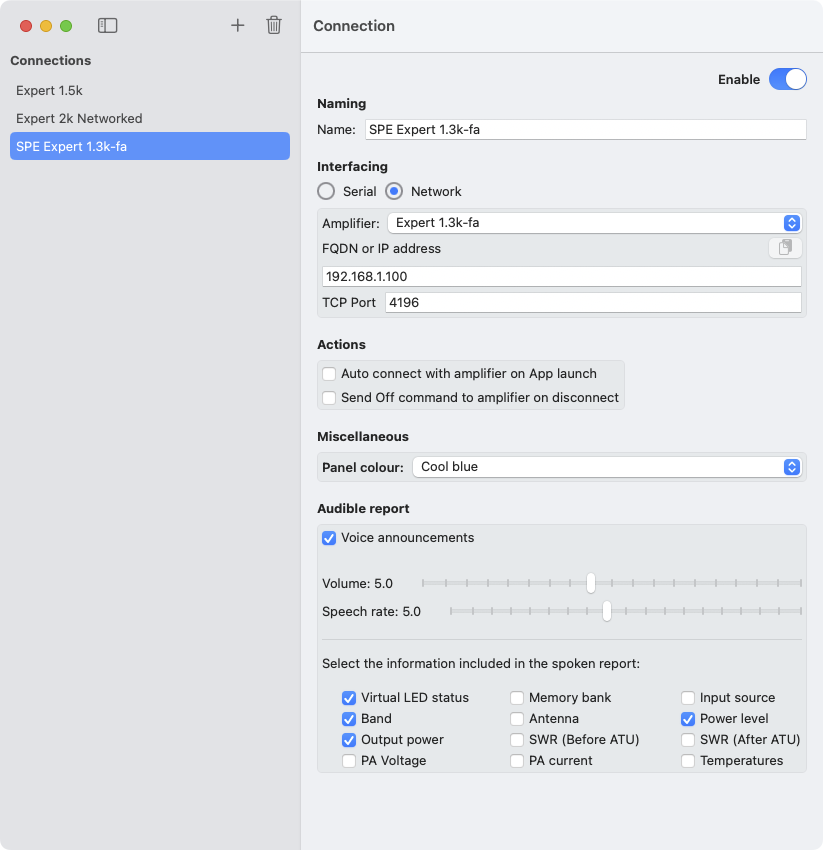
The new SPE Expert Controller will allow the creation of multiple ‘connections’ each of which could use a USB or TCP/IP interface. The vision is that these ‘connections’ will operate independently of each other and look similar to how SPE Expert Controller does today. So, a menu selection like File | Open | New connection would open a window permitting a new connection to be established. These windows would have the amplifier LCD panel display and the usual buttons to switch between Standby/Operate, Set mode etc.

Connections
Connections

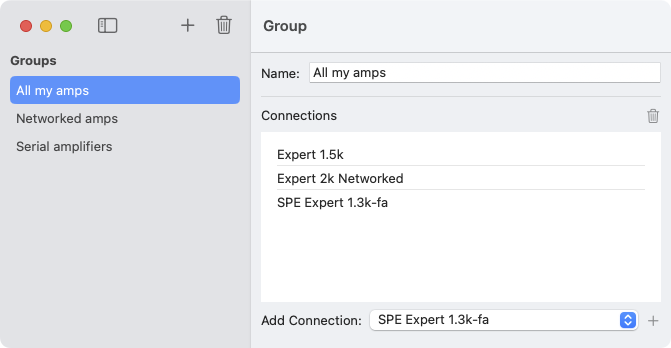
Additionally, the App will include a ‘group’ concept that would allow ‘connections’ to be grouped and actions on a selected group to be performed. These groups could relate to any concept we wish so, ‘Local amplifiers’, ‘Remote amplifiers’ or ‘Serially interfaced amplifiers’ etc.

Groups
Groups

The sharp-eyed reader will also note that the ‘Interfacing’ section of the Connections window contains a new ‘Amplifier’ field. This provides a capability for a Connection to relate to a specific model of SPE amplifier; a useful ability should SPE implement different management interface protocols in future. And as I’m sure some readers are already thinking….what about the 1k-fa? Well it does provide a means to support that amplifier too. That’s not to say it will, but it certainly could…..

It’s not certain yet whether this new version of SPE Expert Controller will come to fruition as there is a lot of work outstanding and a number of technical difficulties to overcome. I’ll continue to provide updates here when there is something significant to report.

Andy

SPE Expert Controller – V1.2.2

This morning I have published the revised User Guide and Release Notes for V1.2.2 in readiness for its release. V1.2.2 is currently in the Apple Appstore review process and once complete will roll-out to all users over the following seven days.

V1.2.2 of SPE Expert Controller is a minor update. It now correctly identifies the 1.5k-Taurus amplifier in the Health window and clarifies SWR measurement field labels in the RF Information window. The clarification removes any ambiguity that arose as to which SWR sensor the fields represented. This latter change has also been reflected in the vocalised audible report.

Andy

SPE Expert Controller – Update

The latest release of SPE Expert Controller (V1.2.1), and all earlier versions, work with the 1.5k-Taurus amplifier model. However, recent comms with SPE regarding specification missing from their Application Programmers Guide has identified that SPE Expert Controller isn’t identifying the Taurus model in its ‘Health information’ window. So instead of titling the window “SPE Expert 1.5k-Taurus Health” it will simply be titled “Health”. The upper value (Watts) for the “RF Power” bar-graph in the ‘RF Information’ window will be 2500 Watts and not scale according to the power level (High, Medium, Low) selected. I’ve updated the software so this will be fixed in the next release.

The next release will also include minor changes to the labelling of the SWR fields in the ‘RF Information’ window so it’s clearer to which SWR sensors within an SPE Expert amplifier they relate. The new labels will be “SWR (Before ATU)” and “SWR (After ATU)”. The spoken, audible report and associated ‘Settings | Announcements’ window fields have also been updated to align with this change.

The release of SPE Expert Controller version 1.2.1 has been successful and no issues have been reported. My plan was that the next release (V1.3.0) would be an update containing UI changes for macOS 26 (Tahoe) but I’m thinking in the interim I’ll push a version 1.2.2 containing the above changes.

Andy

SPE Expert Controller V1.2.1 – Released

Earlier today the latest version of SPE Expert Controller for macOS cleared the Apple App Store review process and is now available from the macOS App Store.

It will become available to all existing users over the next seven days or immedietly for new users and those who initiate a manual update via the App store.

This release includes several minor improvements to UI operation and some bug-fixes. Although update isn’t essential I’d recommend updating to this version especially if you are using a version prior to v1.2.0.

The User guides and Release note sections of this website have been updated so, those curious to see what’s changed can do so in advance of updating. See the Support section.

Andy

Waveshare Net/Serial adapter issues

This is just a short post to alert users of my SPE Expert Controller App that the Waveshare network / serial adapter, specifically model “RS232/485/422 To RJ45 Ethernet Module, TCP/IP To Serial, with POE Function”, firmware V1.452 appears to have what I consider a defect in its DHCP implementation. I wanted to make those who have this device or who are thinking about purchasing this device aware.

Firstly let me give a brief overview of DHCP. When a client using DHCP starts it broadcasts a DHCP Discover message to identify DHCP servers. A server receiving this will Offer an IP address plus other network config information to the client. With this information the client will Request the IP addressing information it wishes to use (as several servers could have responded) and the corresponding server will send an Acknowledgement.

The IP address information Offered has a lease time, a validity time if you like. Once the lease expires the client should no longer use that address information. What a client should do is renew the lease prior to its expiry, often at a period equating to half the lease duration.

OK, with that knowledge I can now say that my Waveshare adapter correctly obtains its IP information on power-on. But it does not appear to respect the lease time so simply continues to use the IP information beyond its lease period / validity period. It does not attempt to renew the lease either.

So what’s the impact of this? Well, two things spring to mind, neither good. As the DHCP server never sees a renewal it expires the IP address and is then within its rights to offer the same address to another client. This results in two devices with the same IP address! That’s going to cause problems. Secondly, its common to configure DHCP servers to push name information to DNS when they allocate an address and to remove that information from DNS when a lease expires. As the Waveshare adapter doesn’t renew the lease my DNS server removes its name from DNS when the lease expires. So name resolution no longer works!

This is not the first time I’ve observed this sort of behavior but its been a few years and that device was another cheap and cheerful Chinese piece of IoT kit.

So, if you have your Waveshare adapter configured to use DHCP and are seeing some hard-to-explain issues, check whether there are two devices using the same IP. If DNS lookups of the Waveshare device are failling after a while (after the lease time) then this is likely the cause.

Andy

SPE Expert Controller – Release update

Since my last post I’ve been regression testing SPE Expert Controller and testing the changes introduced in this version. Doing this identified that whilst the App was connected to an amplifier it was not automatically switching between Light and Dark modes when informed by macOS that a change should occur.

Resolving this simple issue led to a major change in the code behind the facsimile of an amplifier front-panel LCD display. The result is that the main App window is less wide and a little less tall; otherwise it’s pretty much the same. The ‘Announce’ button was also moved to accommodate the reduced window width. I’m pleased, the result is sharper and the font looks less like it’s from the 1980’s! It also now seamlessly switches between Dark and Light modes when informed by macOS.

Complementing the previous colour schemes are now a further two: Green black and White black. Green text on a black background (as Dark mode) and White text on a black background.

I’ve also resolved a couple of other minor defects which had gone unnoticed in earlier versions. Below is the current list of addition/changes. Testing will continue over the next few weeks but the latest build is looking stable so I’m not expecting to find anything major but there may be a few small tweaks yet…

Additions/Changes

  1. The third-party Network/Serial adapter may now be identified using a FQDN (Fully Qualified Domain Name) in addition to an IP address.
  2. Removed ‘Save’ button from the Settings window. Settings now auto-save when choosing an alternate tab or the window is closed.
  3. Enabled the ‘Edit’ menu bar option to better support cut/copy/paste operations.
  4. Added ‘News’ and ‘Support’ to Help menu. These open corresponding pages on the SPE Expert Controller website.
  5. Resolved issue whereby the Settings | Comms tabview did not re-enable the change of information after closing the connection to an amplifier.
  6. The visualisation of an Amplifier’s front-panel LCD changed to resolve an issue switching between Apple Light/Dark modes and to improve sharpness of visualisation.
  7. The colour of the RF Power, PA Voltage and PA Current gauges on the RF Information window are now Green, Yellow and Blue respectively.
  8. Fixed issue whereby the incrementing dots of the Communications interrupted message did not always restart from a single dot after a Disconnect/Connect cycle.
  9. SWR ANT and SWR ATU values swapped to align with observed usage rather than that detailed in the SPE Application Programmer’s Guide. This change impacts the RF Information window and the spoken report.
  10. Two new colours – ‘Green Black’ and White Black’ added to Settings | General | Background colour.
  11. Minor update to underlying datastore. The datastore is automatically updated when version 1.2.1 is first run. The updated store is not compatible with earlier versions.
  12. Miscellaneous minor improvements to internals of the App.

Andy